
Analysis
Three Trucks Reached Kazan. The Next Order Exposed the Factory.
The pilot worked and the buyer ordered five more truckloads. Demand was real; the factory’s production planning, Russian labelling and export discipline were not ready to scale.
In this article
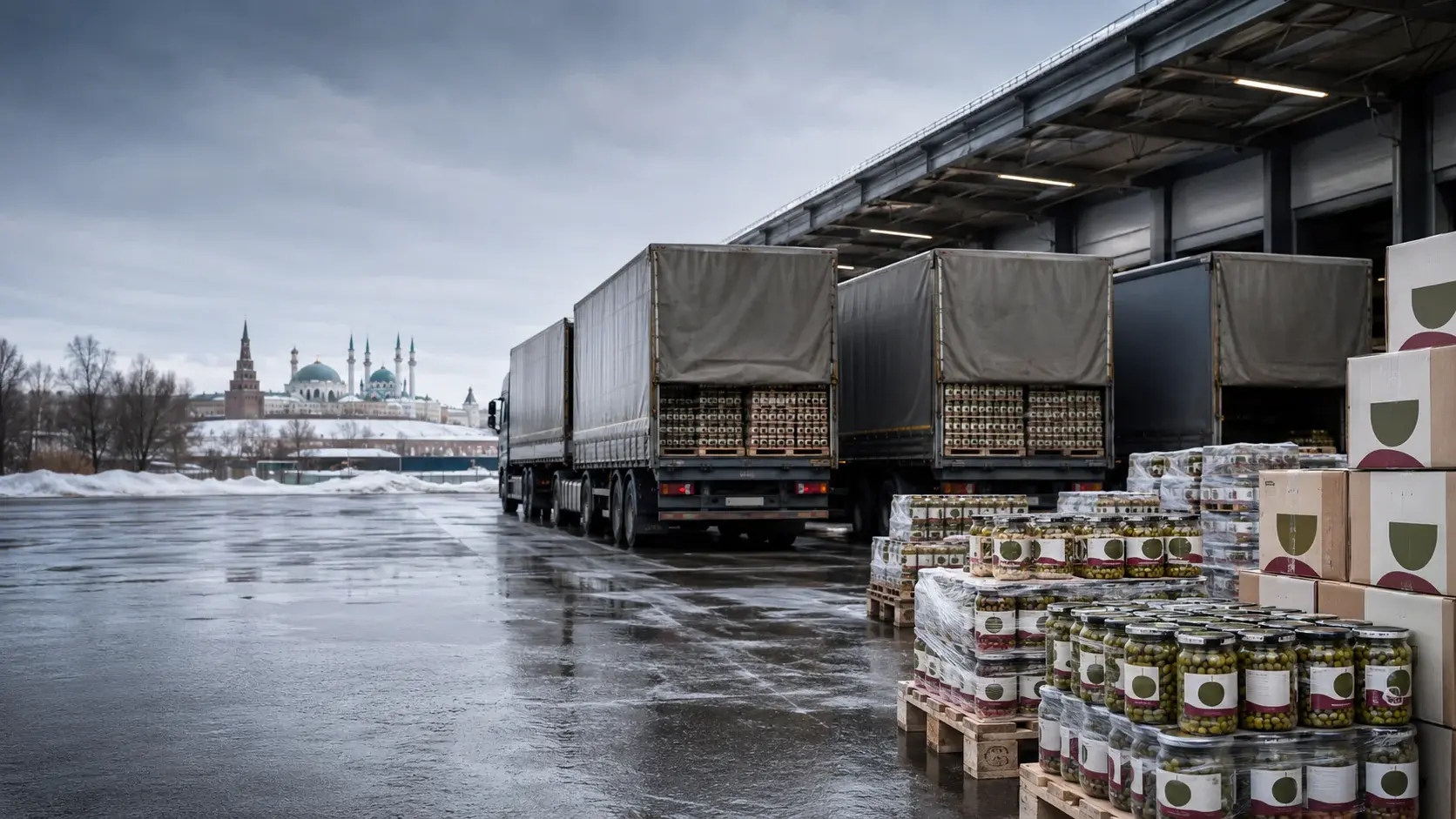
Three truckloads of Iranian olives had reached Kazan and the buyer wanted five more. The route worked, customs cleared the goods and the product sold. Demand was the easy part. The programme stopped because the factory could make good olives but could not keep an export promise at scale.
The case dates to 1402 in the Iranian calendar (2023–24). After a contact suggested testing Kazan for pitted and whole olives, we ran a feasibility review with a trading partner. Because this was our first transaction in the category, we began with one truck rather than treating the buyer’s interest as proof that the whole supply chain was ready.
The pilot proved demand, but nothing more.
The first truck reached the customer without a material problem and was delivered the day after customs clearance. That result answered several useful questions at once: the route was workable, the product was acceptable, and the buyer was serious enough to place a larger order immediately.
The next order was for five trucks. Two more shipments were completed, but production then slipped. The customer asked for updates almost every day. We followed up with the factory just as often, yet the remaining volume could not be prepared on the agreed schedule.
Good olives did not make an export-ready factory.
When we reviewed the failure, the market, buyer and transport route still made sense. The weak point was supplier selection. The factory produced good olives for the domestic market: sorting, size, taste and ordinary packaging were acceptable. But export execution required a different level of control.
Production dates were unreliable. Russian-language labels were not ready on time, and part of the labelling work had to be handled at destination. A delay that might be absorbed through phone calls in the domestic market now affected vehicle planning, customs clearance, warehousing and the buyer’s own sales schedule.
Export readiness is a system, not a certificate.
A factory can make a good product and still be the wrong export partner. Before accepting scale, the commercial team needs evidence that production, packaging, documentation and communication can move together under a real deadline.
Capacity must be tested against the promised schedule, not the factory’s theoretical monthly output.
Destination labels and packaging artwork should be approved before the loading window, with ownership for every correction.
Quality must remain stable when volume rises; the sample and the third truck should not come from two different operating realities.
Documents, customs data and dispatch instructions need named owners and internal cut-off times.
A recovery plan should exist for delayed raw material, production downtime or a missed vehicle; it should not be invented after the buyer starts calling.
For wider destination context, Minux’s Russia market page explains the commercial and logistics environment. The practical controls around shipment preparation are covered in the pre-shipment quality inspection guide and the export documents guide. The product examples in those guides differ, but the discipline of verifying before release transfers.
Stopping the remaining order protected more than one sale
We walked away from the factory even though the buyer and the market were still there. That cost us an immediate sale, but continuing would have cost something harder to rebuild: the buyer’s belief that our delivery dates meant anything.
The conclusion is not that domestic manufacturers are unreliable. It is that product quality and execution maturity must be approved separately. Use a live pilot, then review capacity again before scaling: the first truck tests the route; the larger order tests the operating system.
What this case shows and what it does not
This sequence (one pilot, a five-truck follow-on, two further deliveries and an operational stop) belongs to one Kazan case. It says nothing about the size of Russian demand. It does show something more useful: a market can be ready before the supplier is.
Does a successful pilot shipment prove a factory is ready for larger export orders?
No. It proves that the tested volume was delivered under one set of conditions. Capacity, labelling, documentation and communication should be reassessed when the order expands.
What should be checked before confirming several truckloads?
A dated production plan, approved destination packaging, batch-consistency controls, document ownership, vehicle booking dependencies and a written recovery path for delay.
Why stop if the buyer still wants the product?
Because accepting volume without a reliable supplier converts a sales opportunity into reputational and financial exposure. Pausing can preserve the buyer relationship while a stronger supply solution is built.