
Large-format slab packing
How Large-Format Porcelain Slabs Should Be Packed
A buyer-focused checklist for conditioning, A-frames or crates, edge protection, container securing, evidence and safe unloading.
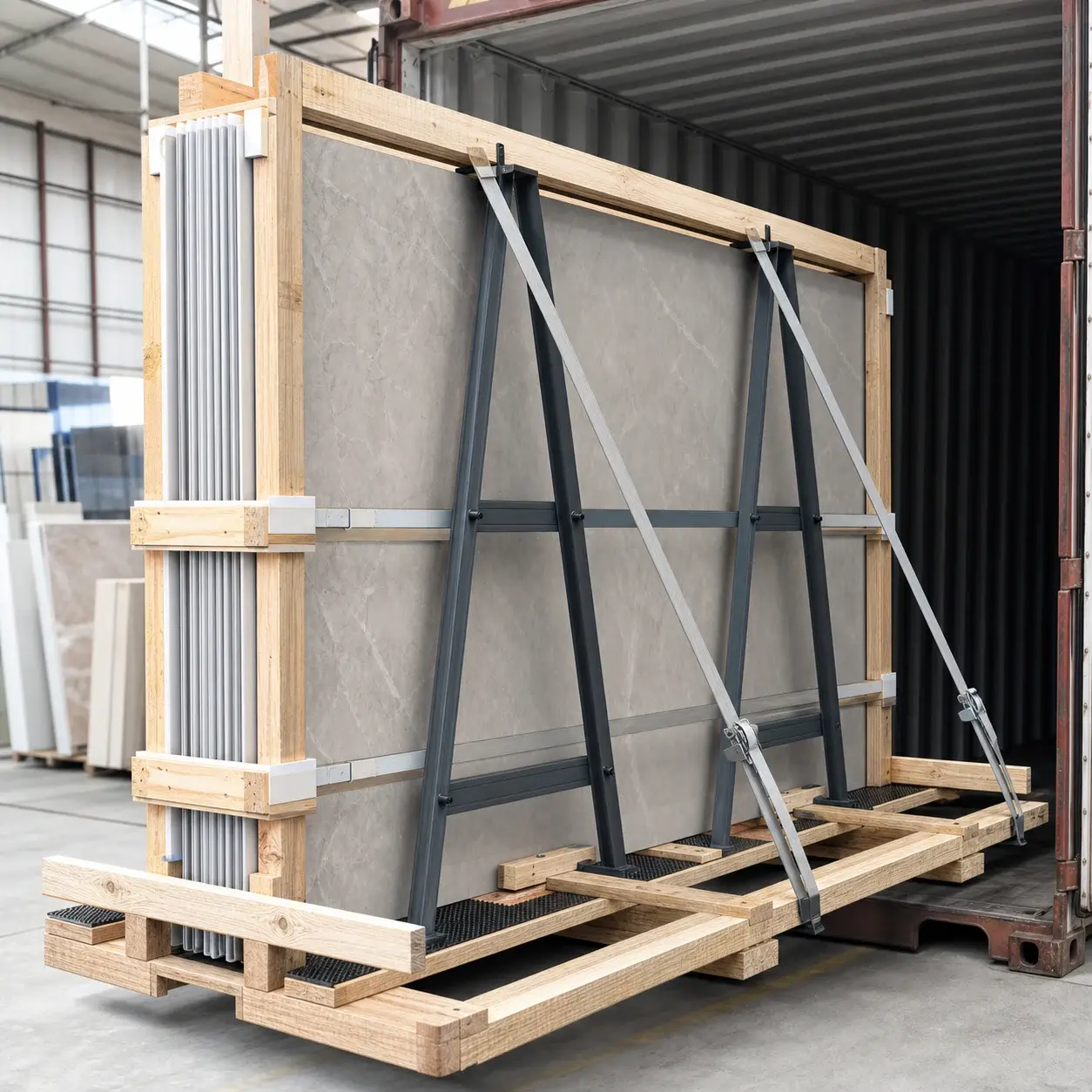
Large slabs fail when the packing system, load path or handling sequence is wrong, not only when the material is weak. Packing must be engineered around slab size, thickness, weight, route, container and destination equipment.
On this page
1. Freeze the slab and handling specification
Record nominal and work dimensions, thickness, surface, edge condition, pieces per package, net and gross package weight and the permitted orientation. Thin or very large slabs may need handling frames or suction equipment and should not be treated like conventional cartons.
Confirm that slabs are clean and dry enough for packing, that protective films or separators are compatible with the surface, and that any required curing or conditioning is complete. Photograph representative faces and edges before they are enclosed.
- Work size, thickness and piece weight
- Permitted vertical or other handling orientation
- Surface protection and separator compatibility
- Package quantity and target gross weight
- Origin and destination lifting equipment
2. Match the support system to the load
An export A-frame, metal rack or timber crate must support the slab where the design expects it, limit movement and avoid concentrated pressure on vulnerable edges or corners. The exact system depends on slab geometry, thickness, bundle size, container and transport route.
Use stable bases, appropriate contact pads, separators, edge and corner protection, balanced loading and secure restraints. Timber and packaging materials should meet destination entry requirements where applicable. A visually heavy crate is not proof of engineering; request the design basis and package weights.
3. Secure the transport unit as one system
Inside the container, packages need a stable load path and verified distribution of mass. Blocking, bracing, anti-slip measures and restraints must prevent forward, rearward and lateral movement under transport forces. The loader should also protect container walls and doors from unsafe pressure.
Container selection, floor capacity, payload limits and verified gross mass must be checked with the responsible logistics parties. Follow the principles of the IMO/ILO/UNECE CTU Code and carrier requirements; do not improvise securing from photographs alone.
- Package and total cargo mass
- Center of gravity and load distribution
- Blocking, bracing, anti-slip and restraints
- Container condition and capacity
- Door safety and controlled unloading sequence
4. Require evidence and an unloading plan
Create a package schedule that links every crate or frame to product, quantity, dimensions and weight. The inspection record should include slab condition, edge protection, restraint points, container condition, loading sequence, final doors area and seal details when available.
The destination team should receive package drawings, weights, lifting points and the unload sequence before arrival. They must provide suitable equipment, a stable exclusion zone and trained operators. Cargo insurance and claim procedures should be aligned with the real value, packing and transport chain.
Guide FAQ
Questions this guide answers
Is a timber crate always enough for large porcelain slabs?
No. Suitability depends on slab geometry, thickness, weight, orientation, route and handling. The crate or frame must support and restrain the specific load.
Should large slabs be packed flat or vertically?
Use the orientation specified by the manufacturer and packing design for the exact product. Handling and securing must remain consistent from factory to final unloading.
What photos should be requested before dispatch?
Ask for representative slab faces and edges, separators and protection, package construction, labels, package weights, blocking and restraints, container floor and walls, door area and seal.
Who approves the destination unloading method?
The consignee and its competent handling contractor should confirm equipment, capacity, lifting points, sequence and safety controls before arrival, using the supplier’s package information.
Search terms for this topic
Phrases buyers use when looking for these products.
- large-format porcelain slabs
- porcelain slab crates
- 120x240 porcelain slabs